How the University of Sussex set a quantum sensing world record
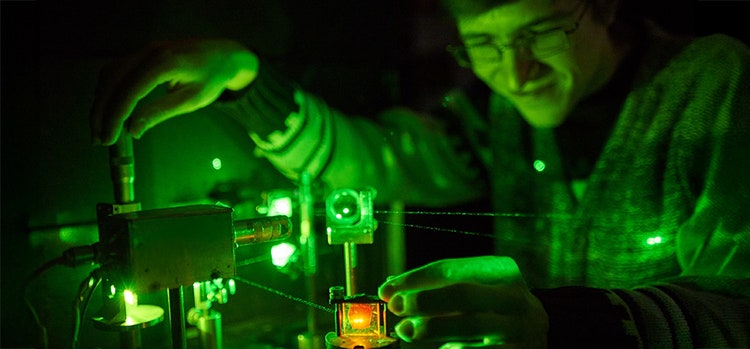
Here's what it means for the future of quantum technology — and for our students.
The discovery at the University of Sussex
The research, published in Nature Physics, represents a significant leap forward in quantum sensing capabilities. Professor Winfried Hensinger, director of the Sussex Centre for Quantum Technologies, explained the innovation:
"We have built a machine that makes use of single charged atoms (ions), capable of unprecedented measurement capability. We have managed to tame some of the very strange phenomena of quantum physics to create a device that can detect low frequency electric fields with unprecedented sensitivity."
What makes this achievement particularly remarkable is its potential for further enhancement. The team has already developed a microchip that could boost sensitivity by another 10,000 times, potentially making the system one million times more powerful than current technology.
Why it matters: real-world quantum applications
Advancing healthcare and brain imaging
Professor James Stone from the Brighton and Sussex Medical School explains:
“It could potentially lead to huge breakthroughs in our understanding of consciousness, as well as of mental illness, and may even be useful in neurofeedback treatments for mental health conditions such as OCD or depression by allowing people to visualise their brain activity and respond directly to it. It could also be useful in neurological conditions such as epilepsy – detecting regions of abnormal activity in deeper brain regions than would be possible with existing EEG methods.”
Enhancing defence and underwater communication
Revolutionising geological prospecting
Strengthening quantum computing systems
Learn more about real-world quantum technology applications.
Innovation at the University of Sussex
The research culture at Sussex emphasises collaboration between disciplines. Students and researchers work alongside world-leading experts who maintain strong connections with industry partners and government agencies. The university's commitment to quantum research has attracted around £100 million in funding, with plans to create a 'Quantum Valley' in Sussex.
The proximity to cutting-edge research means students don't just study quantum technology — they contribute to its development. Many MSc students participate in live research projects, gaining hands-on experience with the same equipment and techniques used in breakthrough discoveries.
Want to be part of the next breakthrough?
Our online MSc in Quantum Technology Applications and Management combines scientific theory with practical business applications. Students develop quantum literacy whilst learning to commercialise emerging technologies — skills that are increasingly valuable as quantum research transitions from laboratory to market.
The programme covers the full spectrum of quantum research, from fundamental physics to real-world applications like the electric field detector. Students learn about:
- Quantum sensing and imaging techniques
- Photonics and atom-light interactions
- Quantum networks and secure communications
- Materials for quantum and nanotechnologies
- Market analysis and technology commercialisation
What sets this Masters degree apart is the integration of business-focused learning with cutting-edge science. Students don't just understand the technology — they learn how to bring it to market, assess its economic potential, and develop strategies for quantum entrepreneurship.
The programme's flexibility allows working professionals to study alongside their careers, with six start dates per year and online delivery that accommodates global participants. Many students form connections that lead to career opportunities in the rapidly expanding quantum technology sector.
Ready to shape the quantum future?
Explore our online Quantum Technology Applications and Management MSc programme today.